
Is underlying Stress Affecting your gut Function?
I constantly hear people telling me in clinic,
“I’m not really that stressed.”
Seems insane, I know, and sometimes they’re right. But most often, we uncover poor sleep, long working hours, skipped meals, multiple coffees, fatigue, muscle tension.
Most people think of stress as mental tension: anxiety, overwhelm and inability to cope.
But this thinking is too narrow. We adapt to stress until stressful states begin to feel normal.. Your body may show signs of stress even when you no longer consciously recognize it.
You Don’t Have to Feel Stressed to Be Stressed
Stress isn’t necessarily bad. It’s a survival mechanism that helps us adapt. It wakes us up in the morning and gets us going.
The problem starts when our body keeps mounting a stress response. It’s this stress response that becomes the long-term issue.
So instead, we ask, how are you sleeping? Do you wake refreshed? Can you switch off at night? How much caffeine do you need? Do you clench your jaw? Has your appetite or digestion changed?
These questions help us identify whether your body is under stress despite not feeling it.
Can Stress Show Up in Your Blood work?
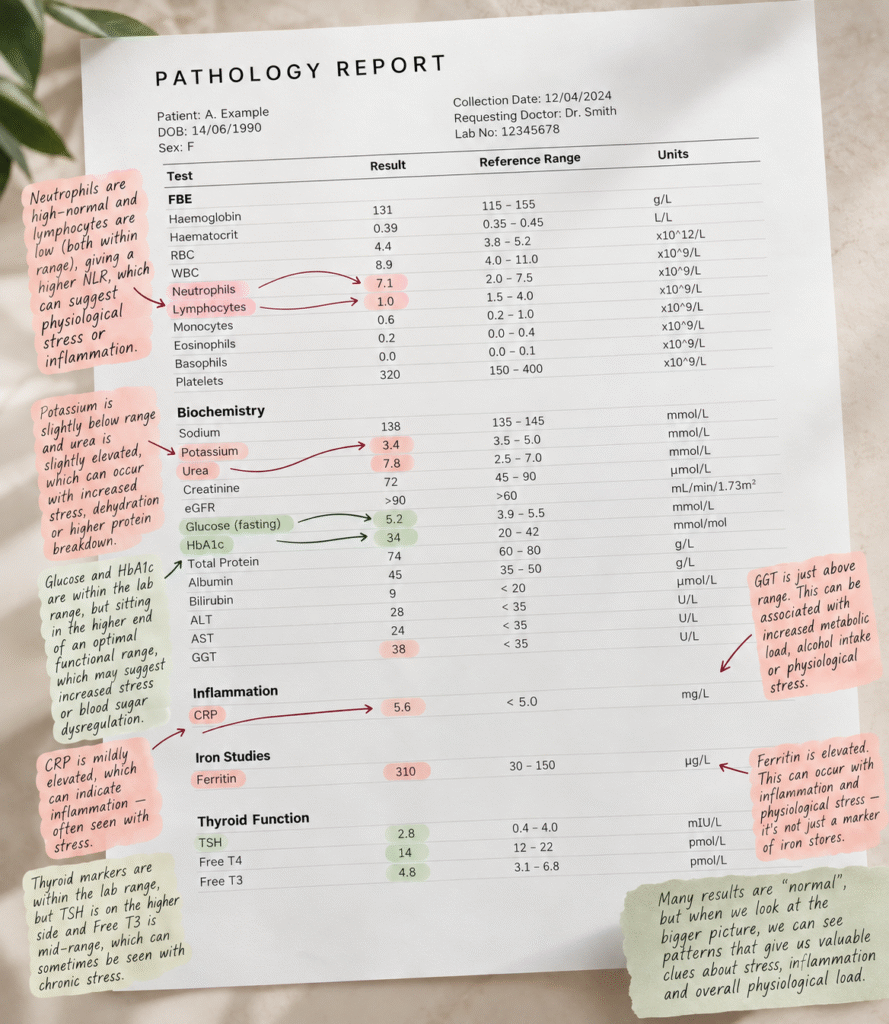
There isn’t one blood test that tells us whether someone is stressed. Instead, functional blood work allows us to look for patterns across multiple markers.
These are some of the markers I look at in clinic to help me identify excessive stress in a client:
Sodium + potassium – The first markers I look at when thinking about adrenal dysfunction and stress
CRP – a non-specific marker of inflammation. Inflammation and stress go hand-in-hand
Ferritin – this marker goes up in stress and inflammation. It’s not just for iron storage
Urea – Stress can increase protein breakdown causing urea to go up
Neutrophil:lymphocyte ratio – stress can alter white blood cell distributions
And, I haven’t even mentioned cortisol yet.
Sometimes, we can find answers without extravagant testing. Many of these markers are already part of common GP blood work. But rather than simply asking whether they’re within the “healthy” reference range, we can look at how they interact by using different, more “optimal” ranges.
Now I have to come clean.
I can’t say “you are stressed” from these markers alone. But as more pieces begin pointing in the same direction, the picture becomes clearer.
It’s kind of like walking into a kitchen and finding a bunch of ingredients out on a bench that look like someone was making a cake. They might be making as cake, but until they come back from the store with the rest of the ingredients, we can’t know for sure.
So, we look at the other ingredients for stress:
Glucose, HbA1c, TSH, fT4, fT3, Uric acid, magnesium, insulin, triglycerides, HDL, ESR, vitamin D, B12, folate, Omegas, creatinine, eGFR, liver markers, creatine kinase, DHEA-S and of course, cortisol.
Each gives us a small piece of the puzzle. Together, they build a picture.
What Happens Inside the Body When We’re Stressed?
When we’re under stress, the body begins prioritizing.
Resources are directed towards what your body thinks is most important right now. Your nervous system, cardiovascular system and energy metabolism respond to help you deal with the perceived demand.
Digestion, recovery and sleep don’t necessarily receive the same priority when your body thinks it needs to deal with something more immediate.
And your gut is one of the best examples.
How Does Stress Affect Your Digestion?
Stress can change how quickly food moves through the digestive tract, influence appetite and digestive secretions, and change how strongly we feel what is happening inside our gut.
For some people, this looks like constipation.
For others, diarrhoea or urgency.
It can also contribute to bloating, reflux, nausea, abdominal discomfort or simply feeling like your digestion isn’t working the way it normally does.
Stress can also change how strongly our nervous system perceives sensations coming from the digestive tract. Gas, stretching and normal intestinal contractions may become much more noticeable or uncomfortable.
So, when someone tells me their gut suddenly gets worse during a busy week, after several nights of poor sleep or during a particularly stressful period, it’s worth exploring.
Can Your Gut Make You More Stressed?
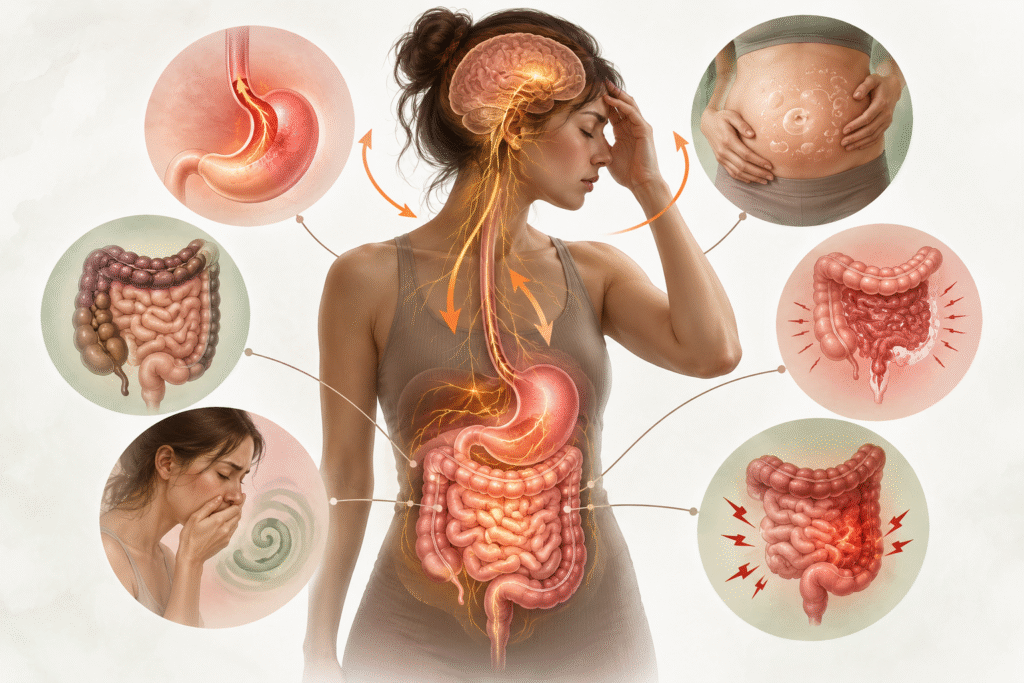
The relationship also works in the other direction:
persistent digestive symptoms can become their own source of stress.
You start wondering what you can eat. Whether you’re going to become bloated after dinner. Where the nearest toilet is. Whether that food you ate yesterday caused today’s symptoms.
Before long, the gut itself becomes something you’re constantly thinking about.
This is why looking at the gut without considering sleep, stress, lifestyle and the nervous system can mean we miss part of the picture.
It’s About the Pattern
Stress isn’t automatically the cause of every symptom.
Fatigue isn’t always stress. Bloating isn’t always stress. Poor sleep isn’t always stress. And an abnormal blood marker certainly isn’t always stress.
But when several pieces start pointing in the same direction, it gives us something worth investigating.
The goal isn’t to find one marker that proves you’re stressed.
It’s to understand the pattern your body is showing us.