
Why FODMAPs?
If you’ve struggled with bloating, gas, abdominal pain or unpredictable bowel movements, there’s a good chance you’ve heard about FODMAPs and probably tried a low FODMAP diet.
If this worked, great! But this isn’t a long-term solution. It’s a short term tool. Long-term FODMAP dieting can actually make it worse.
What are FODMAPs?
FODMAP stands for Fermentable Oligosaccharides, Disaccharides, Monosaccharides and Polyols. Sounds confusing right?
Despite the name, FODMAPs are simply categories of carbohydrates found in many everyday foods.
Each letter (except for A) represents a different category of carbs.
You find them in in garlic, onion, wheat, legumes, dairy products, apples, pears, stone fruits, cashews and many other fruits and vegetables.
But, these aren’t “bad” foods. They’re healthy foods.
“I react to FODMAPs” isn’t the end of the investigation.
It’s information we can use to ask better questions.
“What FODMAPs are you reacting to?”
“Why are you reacting to them?”
“How do you eat?”
“What other symptoms are you getting?”
I see so many people restrict all FODMAPs without trying to find out which one they react to. This is simply overkill.
Understanding more about your gut can help reduce how much you restrict yourself.
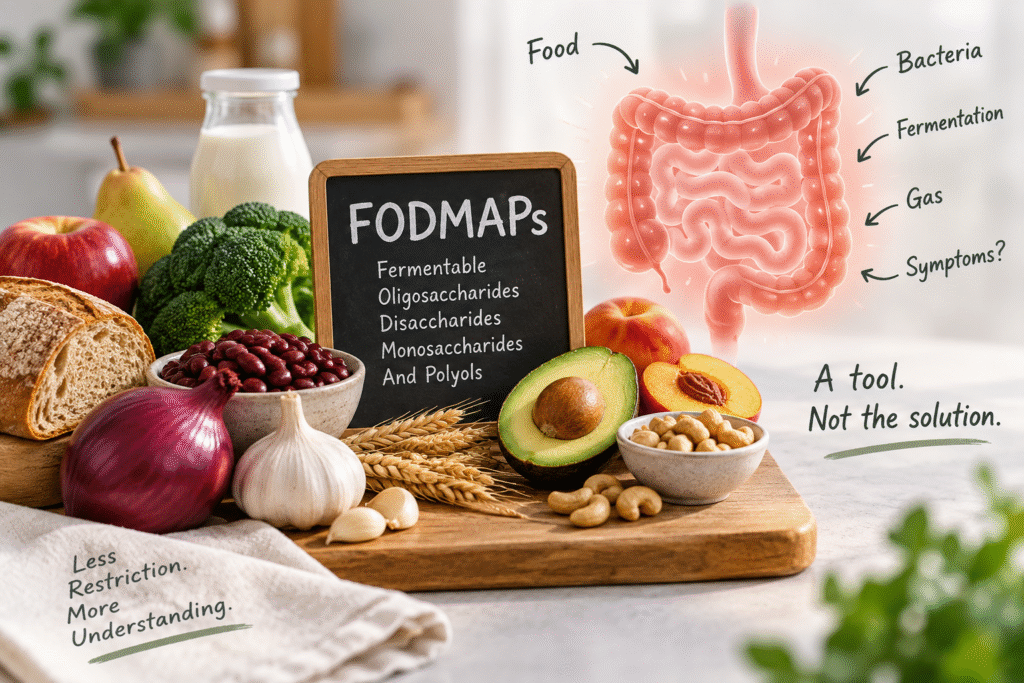
Why do people react to them?
Fermentation is normal.
Your gut bacteria are supposed to ferment carbohydrates.
The problem arises when it becomes too much or the gut is too sensitive.
So, why can one person eat these foods without a problem, while another becomes extremely uncomfortable?
FODMAPs are a tool, not a diagnosis
Feeling better on a low FODMAP diet simply tells us you react to foods.
But it doesn’t necessarily tell us why you’re reacting to them.
Think of it like turning down the volume on a speaker. The noise has gone down, but the music is still playing.
Temporarily reducing FODMAPs can be extremely useful. It can help settle symptoms, identify which carbohydrates you’re particularly sensitive to and give us information about what’s happening within your digestive system.
What does it mean when we can’t have FODMAPs?
It simply means your gut can’t tolerate the amount you’ve eaten. It generally indicates a bacteria population has grown too large or too small or in the wrong place, and this can identify issues occurring higher up in the digestive processes.
Food reactions aren’t always black and white. It is most likely not the food causing the problem.
Why is your gut so sensitive?
Sometimes the amount of gas isn’t the entire problem. It’s how your gut responds to it.
Some guts are simply more sensitive to the expansion that gases from fermentation creates.
An amount of gas that one person barely notices may feel painful or extremely uncomfortable to someone with a sensitive gut.
Stress, previous gut infections, altered bowel movements, changes in the microbiome and ongoing digestive symptoms can all change a gut’s sensitivity
Digestive health isn’t simply about identifying a food and removing it.
The GOAL
The goal should not automatically be to remove every food that produces symptoms.
Reducing FODMAPs can calm symptoms and give the digestive system some breathing room, but wherever possible, the long-term goal is greater tolerance and greater dietary diversity.
That might mean:
- Improving bowel regularity.
- Supporting digestive function from the top down and restoring how digestion should function.
- Working on gut motility.
- Gradually increasing different types of fibre.
- Nourishing the microbiome.
- Improving the gut-brain relationship.
These are things that can all be addressed to better handle FODMAPs
You may never tolerate every FODMAP in every quantity. And honestly, no one can.
Instead of stopping at:
“I can’t eat FODMAPs.”
I want to know:
“Why can’t your gut tolerate them?”
Because that’s where we can start working towards the real goal and getting you back to tolerating foods again