
Smelling & Chewing
Digestion doesn’t start in the stomach. Your body begins preparing for food before you even swallow your first bite.
Smelling & Chewing: Digestion Starts Before You Swallow
When we think about digestion, we usually think about the stomach, intestines and microbiome. I don’t know how many times I’ve seen a product or supplement designed to improve gut function by targeting the microbiome. Probiotics, fibres, herbs, diets. These can all be great, but there’s a lot that needs to happen before food ever reaches our gut bacteria.
Sometimes we need to go right back to the beginning and look at HOW we eat, not just WHAT we eat.

Your Nervous System Knows Food Is Coming
Have you ever smelled food and suddenly noticed your mouth watering? You haven’t eaten anything yet, but your digestive system has already started responding.
The sight, smell, thought and anticipation of food trigger what’s called the cephalic phase of digestion. Your brain recognises that food is coming and sends signals through your nervous system to start preparing your digestive tract.
This can stimulate saliva, stomach acid and digestive secretions, stomach movement and pancreatic secretions.
Essentially, your brain is helping boot up your digestive system before you even start eating.
Think about smelling dinner cooking or walking past a bakery when you’re hungry. Now compare that with eating lunch while answering emails, driving or scrolling through your phone.
The food might be exactly the same, but the way you’re approaching that food is completely different. You don’t need to meditate every time you eat. But eating should be a sensory experience.
Look at your food. Smell it. Taste it. Enjoy it.

Why Do People Say You Should Chew 20–30 Times?
We’ve all heard the advice to “chew your food 20–30 times.” But why?
Chewing isn’t simply about making food small enough to swallow. It physically breaks food into smaller particles and, importantly, mixes it thoroughly with saliva.
As we chew, we stimulate more saliva. This makes food easier to swallow, but saliva is doing much more than just making our food wet.
What’s Actually in Our Saliva?
Saliva contains digestive enzymes including amylase and lipase, which begin the chemical digestion of carbohydrates and fats.
It also contains secretory IgA (sIgA), an important part of our first-line mucosal immune defence.
sIgA can interact with microbes and antigens entering through the mouth, helping our body manage what we’re exposed to before it travels further into the digestive tract.
Chewing therefore does several things at once:
Breaks food apart → increases surface area → mixes it with saliva → begins chemical digestion → exposes it to protective components in saliva → prepares it for the next stage.
And that next stage is the stomach.
Your Stomach Doesn’t Have Teeth
This is one of the simplest ways I explain the importance of chewing.
Your stomach can churn, mix, acidify and chemically digest food, but it can’t chew it for you.
If you’re taking huge mouthfuls and barely chewing before swallowing, you’re changing what you’re asking the next stage of digestion to deal with.
As I discussed in my previous article, digestion happens in a sequence:
Brain → Mouth → Stomach → Liver/Gallbladder/Pancreas → Small Intestine → Large Intestine & Microbiome
What happens at the beginning can influence what happens further down.
Do You Actually Need to Chew 30 Times?
No.
I don’t particularly like giving everyone an arbitrary number of times they need to chew every mouthful.
A spoonful of yoghurt and a piece of steak obviously don’t require the same amount of chewing.
Instead, ask yourself:
Has the food been broken down properly? Has it mixed thoroughly with saliva? Is it soft and easy to swallow?
For someone who eats incredibly quickly, aiming for 20–30 chews can still be useful. Not because 30 is some magical number, but because counting temporarily can help build the habit of slowing down and chewing properly.
How Are You Eating?
Next time you eat, pay attention to what you’re actually doing.
Are you always the first person to finish? Are you taking another mouthful before you’ve swallowed the previous one? Are you scrolling through your phone? Do you predominantly chew on one side? Do missing teeth, jaw pain or clicking change how you chew?
These are simple questions, but they can tell us a lot about the very first stages of digestion.
You don’t need to make eating complicated. In fact, I’m suggesting the opposite.
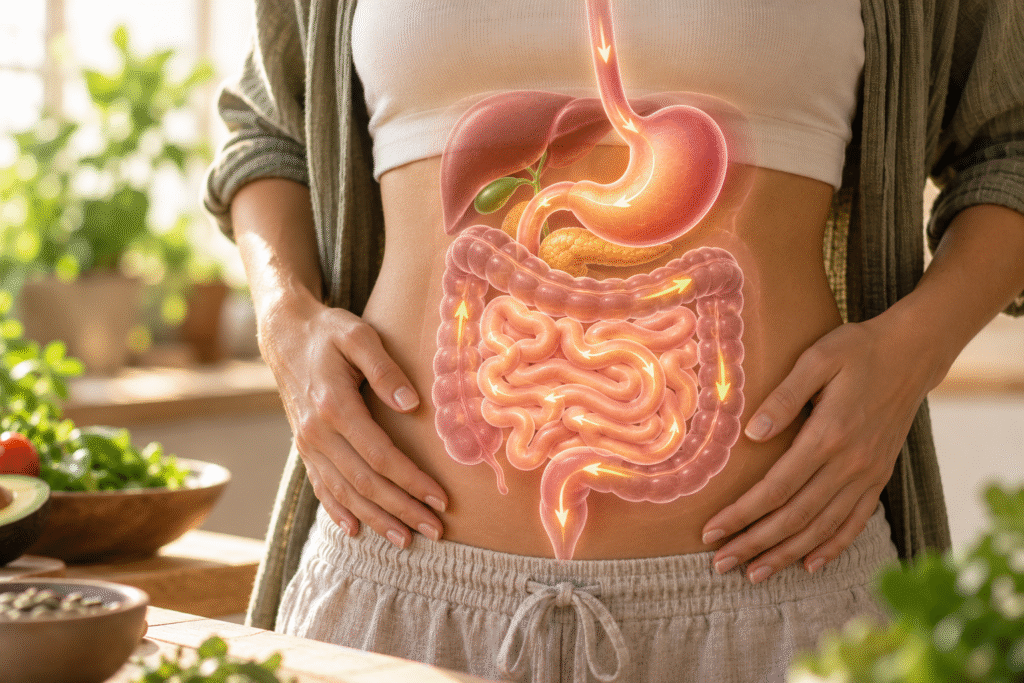
Sit down. Look at your food. Smell it. Chew it. Enjoy it.
By the time food reaches your stomach, digestion has already begun.
And if we’re trying to improve gut function, sometimes it makes sense to start at the beginning rather than jumping straight to the microbiome.